Global American

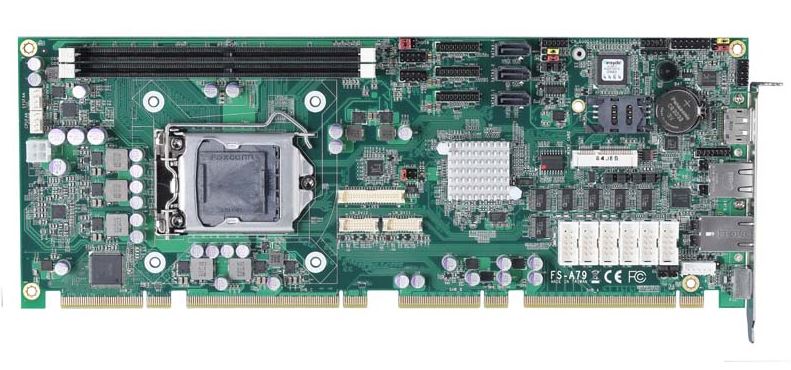
FS-A79 – PICMG 1.3 Full-size SBC

The FS-A79 SBC is based on the Intel Q370 chipset and supports Intel Core 8th Generation Processors and up to 32GB of DDR4 2666MHz.

Additional information

CPU

8th Generation Intel Core Desktop Processors (TDP up to 65W)

CPU Socket

FCLGA1151

Memory Type

DDR4 2666MHz (i3, Pentium, and Celeron CPUs only support 2400MHz)

Memory Slots

2

Maximum Memory Supported

32 GB

Serial ATA (SATA)

3 x Serial ATA3 interface up to 600MB/s Support RAID 0, 1, 5

Audio Chipset

Realtek ALC262 HD Audio

LAN Ports

1 x Intel I210 & 1 x Intel I219-LM Gigabit Ethernet Controller

GPIO Interface

1 x Onboard programmable 8-bit digital I/O interface

GPIO Port

1 x Onboard programmable 8-bit digital I/O interface

Display

2 x DVI, 1 x DP, 1 x VGA, 1 x LVDS

Extended Interface

Supports (1) PCI-Express x16, (1) PCI-Express x4 or (4) PCI-Express x1, (4) PCI, mSATA (mSATA only supports SATA3)

Internal I/O

2 x RS232/422/485, 4 x RS232, 1 x GPIO port, 1 x Audio connector, 1 x SMBus connector, 1 x VGA, 1 x LVDS, 2 x DVI, 1 x LPC, 4 x USB2.0 and 6 x USB3.1 Gen2 ports, 3 x SATA3

External I/O

1 x PS/2 Keyboard/Mouse Port, 1 x DisplayPort, 2 x RJ45 LAN Ports

Ordering Options

Ordering Options

FS-A79 – PICMG 1.3 Full-size SBC

The FS-A79 SBC is based on the Intel Q370 chipset and supports Intel Core 8th Generation Processors and up to 32GB of DDR4 2666MHz.

CONTACT US NOW

Motherboard * 

CPU

Memory

mSATA Drive

2.5″ Hard Disk Drive / Solid State Drive

Testing (Only available if an entire kit is purchased)

SKU: 3308659 Tags:

Additional information

CPU

8th Generation Intel Core Desktop Processors (TDP up to 65W)

CPU Socket

FCLGA1151

Memory Type

DDR4 2666MHz (i3, Pentium, and Celeron CPUs only support 2400MHz)

Memory Slots

2

Maximum Memory Supported

32 GB

Serial ATA (SATA)

3 x Serial ATA3 interface up to 600MB/s Support RAID 0, 1, 5

Audio Chipset

Realtek ALC262 HD Audio

LAN Ports

1 x Intel I210 & 1 x Intel I219-LM Gigabit Ethernet Controller

GPIO Interface

1 x Onboard programmable 8-bit digital I/O interface

GPIO Port

1 x Onboard programmable 8-bit digital I/O interface

Display

2 x DVI, 1 x DP, 1 x VGA, 1 x LVDS

Extended Interface

Supports (1) PCI-Express x16, (1) PCI-Express x4 or (4) PCI-Express x1, (4) PCI, mSATA (mSATA only supports SATA3)

Internal I/O

2 x RS232/422/485, 4 x RS232, 1 x GPIO port, 1 x Audio connector, 1 x SMBus connector, 1 x VGA, 1 x LVDS, 2 x DVI, 1 x LPC, 4 x USB2.0 and 6 x USB3.1 Gen2 ports, 3 x SATA3

External I/O

1 x PS/2 Keyboard/Mouse Port, 1 x DisplayPort, 2 x RJ45 LAN Ports

Ordering Options

Ordering Options

Some of our successful brand partners

Acrosser logo

Already know what you need? Request a quote.

We can customize the perfect solution to meet your embedded computing needs.

  • This field is for validation purposes and should be left unchanged.

Latest Articles

Company News

  • 7 Reasons to Work with Global American

    With our long industry experience and knowledge dealing with every stage of the embedded manufacturing pipeline, we understand the needs of this task and have helped multiple clients through it. So here are the 7 reasons to choose Global American as your embedded partner. #1: Reputation for Delivering Back in 1989, when embedded computers were still just […]

    View Article
  • Global American Brings MACTRON Group’s Panel PCs to the US

    Panel PCs have become ubiquitous across industries, thanks to their ease of use and small size. And MACTRON Group is one of the world’s leading manufacturers of touch-based panel PCs, especially in healthcare and industrial automation. With America looking to step up domestic manufacturing massively in the coming years, the need for small embedded computers […]

    View Article
View All News

From the Blog

  • Why Edge Has Overtaken Cloud for Embedded Computing

    Cloud computing established itself as the standard of enterprise computing a while ago. While this stays true for web-based applications, other industries are seeing a shift. Edge computing has emerged as a swiftly growing paradigm, with more and more embedded applications relying on edge architectures.  But what’s the difference between Edge and Cloud computing? And why is Edge gaining ground? Is AI related […]

    View Article
  • FPGA vs SoC: Which is Better for Your Embedded Application?

    Powerful embedded PCs that use the latest Intel or AMD chips are useful, but also unnecessary for many applications. There are many specialized tasks that do not require that kind of power, but rather a more efficient system, both in terms of the cost and operating energy.   Once this need was met by ASIC systems, containing hardware specially designed […]

    View Article
View all Blogs